Wednesday, 22 February 2012

A tiny art gallery, and a huge museum

Several weeks have again raced by without me posting anything which is pretty rubbish really. In my defence, I have been doing quite a lot of writing, it's just not been for the blog! This is another lazy post in that it's made up of two articles that I wrote for the same travel website as the sumo article (japantourist.jp). I'm really enjoying doing these articles. The research for them is allowing me to continue discovering new parts of Tokyo, as well as re-visiting places I first went to six months ago. It's very interesting to see how both the places and I have changed in that time. Anyway, your comments would be very much appreciated so let me know what you think!


Space Oguraya

It is easy to forget you are in one of the world’s busiest cities during a visit to Space Oguraya, a tiny arts and crafts gallery opposite a serene Buddhist temple on one of Yanaka’s many picturesque, winding streets. At first glance, with its black walls and rusting corrugated iron tower, the gallery looks a little uninviting. But persevere through the door and you’ll be pleasantly surprised by the homely, rickety entrance hall full of paintings that lies on the other side. Often the gallery owner, Takao Itoh, will be there greeting visitors, asking you to remove your shoes and replace them with a pair of quaint floral slippers provided in a basket in the hall.


Slightly forbidding from the outside...
...but homely and welcoming inside.

Many of the works on display are by Itoh-san’s mother, Toshi Itoh. Hanging in the entrance is an atmospheric winter’s day view of the temple gate opposite. Itoh-san told me that his mother painted it while looking out of the upstairs window in the gallery. The tiny dog that is just visible was the temple’s guard dog, barking loudly at passers-by but never venturing beyond the line of the gate.


Yanaka in Winter by Toshi Ito
Temple's Gate in Autumn by Toshi Ito


Other paintings at Space Oguraya are by Japanese and foreign artists, and there are often small displays of origami and other Japanese crafts. The exhibitions change with the seasons although there are always some of Toshi Itoh’s works on display. There’s also a well-stocked shop where you can pick up prints and postcards of some of the gallery’s holdings.


Interesting art in a beautiful setting

While you’re in the area it’s worth crossing the road to have a closer look at the temple opposite; it’s inspiring in its peacefulness. Also, spend some time just wandering around the tiny streets to see what other surprises might be there – more temples than you can count and several other small art galleries quietly wait to welcome the visitor who prefers their sites off the beaten track.


The entrance to the temple opposite Space Oguraya

For me it’s not the art, although interesting, that keeps me returning to Space Oguraya; it’s the feeling of the place. In the wooden walls and creaking floorboards, in the experience of shuffling around in slippers, and in Itoh-san’s stories, there is a little bit of Yanaka magic just waiting to be discovered.


Tokyo National Museum

If you’re looking for a historical treasure-trove of Japanese arts that will give you an overview of some of the most important and influential techniques, products and traditions to come out of Japan, Tokyo National Museum is the place for you.


Amazingly beautiful 16th century screen
19th century parody of the twelve months

The permanent collection, located in the Honkan (Japanese Gallery) is brought together under the title, Highlights of Japanese Art. The information tells visitors they are about to embark on a “cultural journey through time” and the gallery lives up to this claim. The earliest items in the collection are clay pots and jars from the Jomon Period (10,000-500 BC). From there you are taken on a whistlestop tour that ends up in the current Heisei Era, having touched on everything in between. There is plenty of English around on the labels in the galleries, as well as guides and maps in English, French, German, Spanish, Chinese and Korean so it’s easily navigable by foreign visitors.


16th century picture of
the moon and a plum tree

Even in this collection of highlights there are some things that particularly stand out: the kimonos and lacquer-ware items show off the tremendous skill of the artists through their tiny and beautiful details; the samurai armour and swords are fascinating for their precision and the air of danger that hovers around them; the 1000-armed Buddhas are awe-inspiring in their craftsmanship and serenity.


15th century samurai armour
Intricate detail on a 19th century kimono


In addition to the permanent displays in the Honkan, there is also a programme of small, thematic, temporary exhibitions. These showcase items belonging to a particular collector, or a collection that is relevant to a specific time of year (for example Hina Matsuri – Doll Festival – on 3rd March). Then there is the huge special exhibitions gallery, the Heiseikan, which houses a large archaeological collection, as well as being the location for the major temporary exhibitions that the museum hosts. Recent shows have looked at Buddhism, the relationship between Chinese and Japanese art, and manga, with forthcoming exhibitions scheduled to focus on calligraphy, Chinese dynasties, and sacred Japanese treasures.


Seated Nyoirinkanan Bosatsu from the 13th century


Tokyo National Museum also includes the Hyokeikan and Toyokan buildings, both of which are currently closed for renovations, but scheduled to open again in 2013. Even without these two exhibition areas, the museum is definitely worth a visit.

Spend some time just sitting in the galleries taking everything in. The low lighting and near silence create an atmosphere perfect for contemplation of the beautiful objects, many of which have been designated as National Treasures or Important Cultural Property. These artefacts are not just important to the cultural heritage of Japan, but to that of the whole world. A visit to Tokyo National Museum is an uplifting and inspiring reminder of the beautiful creations of which people are capable and it is well worth half a day of your time.


Inspiring 20th century statue of Kannon

またね!

Thursday, 2 February 2012

Sumo - a belt grabbing, face slapping, belly whacking day out!

The snow has melted in Tokyo and the sun is out again. Our latest visitors departed early this morning after two packed weeks of sightseeing - plenty of notes taken that just need moulding into a coherent post which will be up shortly... In the meantime, I've started doing a bit of writing for a travel website (japantourist.jp) and thought I'd post the article I did for them about the sumo match that Simon and I saw a fortnight ago. Enjoy!


"Leg pounding, face slapping, belly whacking, salt throwing, belt grabbing, bow twirling, crowd screeching, heart pumping…A day at the sumo is a truly wonderful assault on the senses.

Every year there are six honbasho (official sumo tournaments) in Japan. Three of these are held in Tokyo, and one each in Osaka, Nagoya and Fukuoka. It was with great excitement that I recently went along to the first honbasho of 2012 – at Ryogoku Kokugikan in downtown Tokyo.

From early morning to mid-afternoon the lower ranked rikishi (wrestlers) battle it out. The stadium is pretty empty at this time, although it starts filling up around lunchtime. If you’re up for making a whole day of it it’s worth going along for the experience and also because you can occasionally see some young hopefuls on their way up through the ranks.


From around 2.20pm the jūryō, the second highest division, take the stage. These guys are good, and some of them are on their way to being excellent. The division is fixed at 28 rikishi and each one has to fight in 15 bouts in a honbasho. That’s 15 days in a row slamming into your opponent, and trying everything in your repertoire to get them out of the ring or to touch the ground with anything but the soles of their feet before they do the same to you. Ouch.

While you’re at the stadium make sure you wander around to have a good look at everything. Pop into the small but very interesting sumo museum on site (free admission) to see the beautiful antique keshō-mawashi (ornate, ceremonial aprons worn by the top divisions of rikishi). Also check out the Emperor’s Cup in the foyer of the stadium. This is awarded, along with many other prizes, to the winning rikishi on the last day of the honbasho.

The Emperor's Cup


But whatever else you do with your day, make sure that you’re in your seat by 3.45pm because this is the bit that you’ve paid your money for. The makuuchi division contains the top 42 rikishi in the world and these are the hardest fighting, most experienced players who have the most to lose. The building tension in the stadium was palpable as spectators chanted for their favourite players. Like the jūryō, these guys also fight in 15 bouts over the course of the honbasho.

The makuuchi division begins with dohyō-iri (ring entering ceremony) where all the players enter the ring in turn and carry out a ritual to attract the attention of the gods. The highest ranking player then performs his own ritual of clapping, showing his palms to the gods so they can see he is unarmed, and stamping to drive out the evil spirits from the ground. Once the stage is set in this way, the fighting can begin.

The makuuchi perform their dohyo-iri


The top ranked rikishi of all performs his own ceremony

 In the makuuchi division, heights range from around 165cm to over 2 meters, while weights range from around 95kgs to nearly 200kgs. And, with a few limitations, anyone can be up against anyone. For me, the most interesting bouts were the ones where the rikishi were mismatched in terms of height and weight, and therefore the smaller guy had to employ more tactics (slapping, ducking, running, armlocking) rather than just relying on his mass to bulldoze his opponent out of the ring. There are 70 official winning moves at the rikishi’s disposal and each player has his own distinctive style. Some bouts lasted a couple of seconds, others nearly a minute. It’s not necessarily the length of the fights for which you go to see sumo, it’s more about experiencing something uniquely Japanese in its ritual, pomp and circumstance. Having said that, do look out for the non-Japanese rikishi – in the makuuchi division there are currently four players from Mongolia, two from Bulgaria and one each from Brazil, Czech Republic, Estonia and Russia. Legend has it that one of these guys had to dye his blonde hair black and get extensions so that he was able to have the traditional and obligatory chomage (topknot) hairstyle…

Get ready...and...

...FIIIIIGHT!
(apologies for the poor quality photos, we were sitting a way away
and they were moving pretty fast!)

The final act of the sumo day is yumitorishiki (bow twirling ceremony). After all the members of the makuuchi division have battled it out, a third division rikishi enters the ring and twirls a long bow around his head, celebrating the achievements of all the winning rikishi that day. Keep your fingers crossed that he doesn’t drop the bow – if this happens he must pick it up with his foot as to touch your hand to the floor in sumo is to lose and it would be very bad luck to do this in the final ceremony of the day.

And so the sun set on my day at the sumo. As with many things in this country, nothing at the honbasho is done without a reason, whether it’s to honour the gods, to bring fortune or to drive away evil. I would highly recommend it as an insight into some of the intricacies of Japanese ritual and tradition. It’s also seriously good fun!"

またね!

Wednesday, 25 January 2012

Snowkyo!

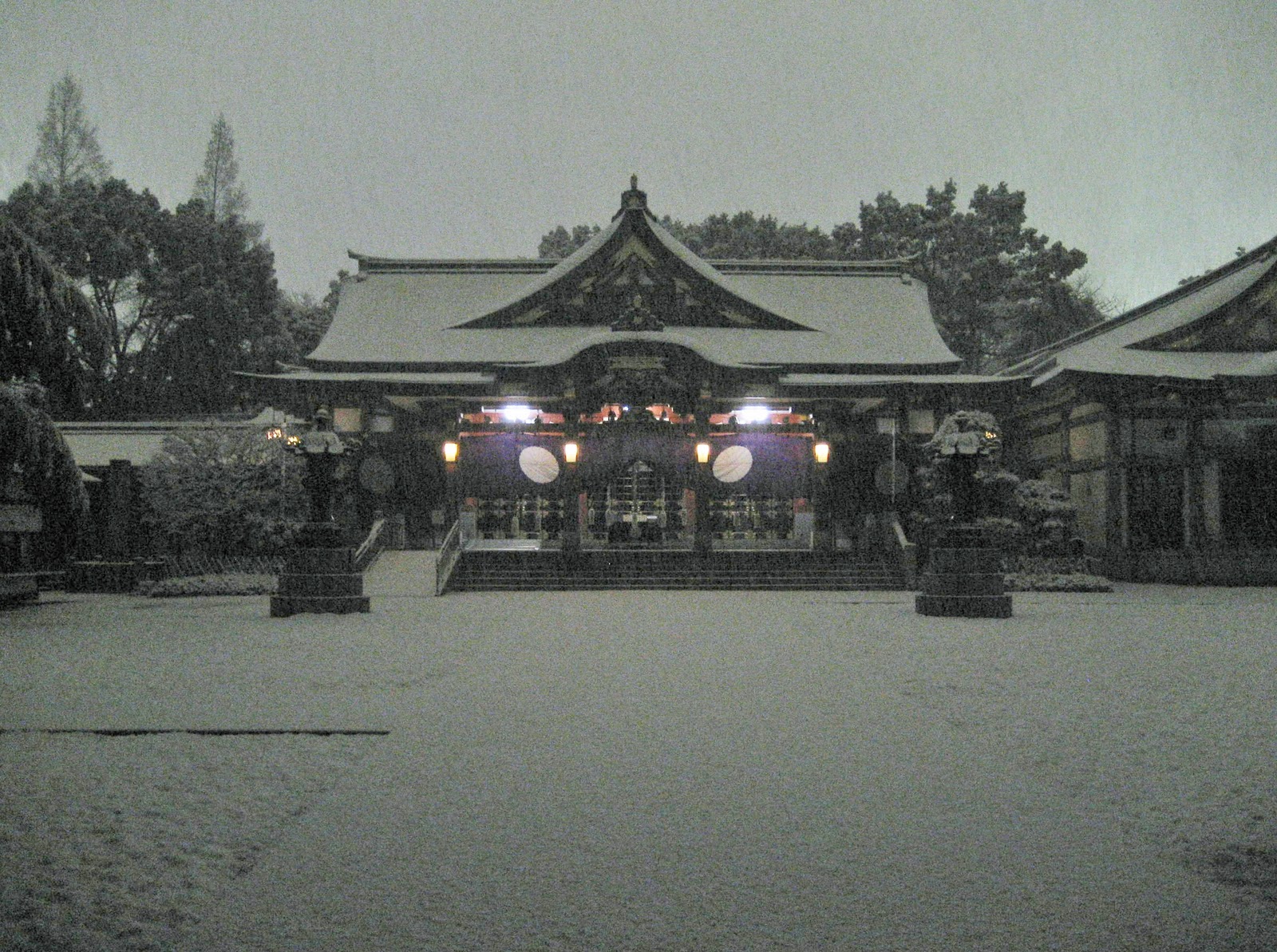
A very short post today: just wanted to put up some pictures of the weather earlier this week (an odd thing to say but I blame the fact that I'm British for being a little bit obsessed with the weather here). It started raining around lunchtime on Monday and it got heavier and heavier until nightfall, when it was cold enough to turn into snow. Proper, thick, clumpy snow. Simon was so excited he insisted we went for a walk round the block at 10pm to get the full experience. It was freezing and very beautiful!

Outside our apartment building

Sotobori-dori

Steps up to Hie Jinja

Main shrine at Hie Jinja

Hie Jinja entrance gate

Tuesday morning - icing sugar all over the city

That's it for today but fear not, I'm saving up more to have a splurge in the near future. Simon's sister, her husband and their 9-month-old son are currently staying with us and I've been having lots of fun with them re-discovering Tokyo from the point of view of a small child. It's actually turning out to be a pretty baby-friendly city for the most part, something that I have to admit I'm quite surprised by. Details of our adventures will be forthcoming soon.

またね!

Friday, 6 January 2012

Tokyo Christmas and New Year

明けましておめでとうございます!

For me, 2012 started at Zōjō-ji temple, looking at Tokyo Tower, listening to the 108 chimes of a giant bell, with a skinful of sake. I’ve certainly never celebrated like that before and it’s one I will always remember. But more on that later – first there’s all the Christmas fun to talk about.

Our Christmas tree arrived about five minutes after I finished my last blog post and I had great fun decorating it with a fairly random assortment of Ikea and 100 yen shop goodies. By the time everyone’s presents were underneath it looked pretty cool!

Kurisumasu tsurii!

My Japanese school term finished with a lovely Christmas party on 21st December which was a great way to round off a term of hard graft. We all brought a dish along to the party and it turned into a veritable multicultural feast as many students cooked something from their own country. In the absence of a deep fat fryer to make fish and chips, I took nuts, crisps and sake.

Lots of food and lovely people, and someone gave me a silly hat to wear

A couple of glugs of beer and rounds of 乾杯 (cheers!) with the head of the school and our class teachers were followed by some serious eating and chatting about plans for Christmas and New Year. Shortly after that my phone rang and it was my brother, saying that he was already at Tokyo Station and was I on my way to meet him…oops! I hastened into town to find him at the station and begin the task of fighting off the jetlag until the evening. He is a complete trooper and we had a full afternoon of sightseeing (gardens and temples) followed by a great dinner of ramen before he eventually turned in. I was seriously impressed.

Action shot!

The next couple of days were all about the sightseeing as we took in the Yasukuni Shrine, the Imperial Palace Gardens, Ginza and Odaiba. Matt’s keeping a blog with his photos from the trip and they are great so have a look at them here: http://matttravelling.blogspot.com/ My photos from the last couple of weeks of December focussed more on the Christmassy things going on in the city. Here are a few of them (and some not-so Christmassy things too).

Some of the red momiji leaves in Hibiya Park hung on into December


This tree reminded me of Alice in Wonderland


A small parade on Chuo-Dori in Ginza


Hiding at the end of the platform at Hamamatsucho Station


Huge tree outside Mikimoto Pearl in Ginza


250,000 LEDs are in the Blue Forest illumination in Shiodome so I competed
by wearing my fancy coat

We decided to have our Christmas lunch a day early so that Simon didn’t have to go to work on Boxing Day with a big hangover so on Christmas Eve we cooked a full turkey roast and sat down to enjoy it wearing fluffy antlers and looking out over sunny Tokyo. Bizarre and very cool.

Horrible photo but I felt that homage to the gaijin Christmas celebrations was required

Christmas Day was also an original experience…after breakfast and presents in the morning we set off on a six-hour hike up Takao-san in the foothills of Mount Fuji. At the top, for Christmas Day lunch, we had pot noodles and sake. Fantastic!

None of us actually managed to take a photo of
lunch so here's one of the view instead

In truly efficient Japanese style, Christmas was over by 7am on 26 December. Simon (on his way to work) sent me a text message to tell me that the 3-storey-high Christmas tree that took two days to put up outside our apartment building had already been cleared away and the space tidied up. In the blink of an eye the New Year decorations were up. These come in different shapes and sizes and are often created from pine sprigs and bamboo. The abundance of green, combined with the almost-ever-present Tokyo sunshine made everything feel wonderfully spring-like all of a sudden. The most prevalent of the New Year decorations is the kadomatsu (gate pine), which welcomes ancestral spirits of the harvest. These are outside almost every office building and restaurant and many homes too. I bought a small one and it’s welcoming the ancestral spirits to our flat. At least I hope the spirits are giving me the benefit of the doubt as my kadomatsu is a) plastic, b) inside our flat because it’s pretty and I can’t see it if it’s outside the door and c) there should be a pair of them (male and female) but I only bought one. Points for effort perhaps?

Outside Mikimoto Pearl, where the Christmas tree was days earlier


Giant kadomatsu in Ginza


And my not-so-giant kadomatsu at home

New Year’s Eve itself was great (the bits I remember of it at least). Matt’s girlfriend Emma arrived at around 7pm and we all watched the traditional TV programme Kōhaku Uta Gassen (imagine if Eurovision had a party with Disney and they all ate a lot of sugar - superb!) on NHK while having drinks and dinner. Emma had come off a mega 24-hour journey so turned in a bit later while Matt, Simon and I headed to Zōjō-ji, a Buddhist temple next to Tokyo Tower. By the time we got there it was rammed! We muscled our way into a decent position from where we could see the temple, the bell that would be rung at midnight and the tower too. We cracked open our cartons of sake and waited for the countdown to begin. At the stroke of midnight, Tokyo Tower changed its display from 2011 to 2012 and hundreds of people in the temple grounds let off clear helium balloons with their New Year wishes attached. We hadn’t got there early enough to get balloons so just drank more sake and watched in awe as the floating wishes sailed off into the night sky.

Hundreds of wish balloons waiting to be let loose


Not much to say about this one...


Rosy cheeks from the cold (or the sake)


Old meets new - an amazing view to have at midnight


Artistic shots fuelled by more sake

A lot more sake was consumed after that, and the less said about my general state on New Year’s Day the better. I managed to get out of the house in the afternoon to do hatsumōde (first shrine visit of the New Year) at our nearest shrine, Hie Jinja. It was amazing to see everyone getting their omikuji (fortune) and omamori (amulet) and queuing to pray and ring the shrine bells. We kept seeing people carrying arrows with bells on them and at the shrine they handed these over to be blessed before taking them home. Simon did some research and found out that these are called hamaya and are sold only during the first few days of the year. The name means ‘demon-breaking arrow’ and their purpose is to ward off misfortune and bring good luck. Well then, 2012 is all set to be a fortunate year for us because we returned to Hie Jinja the next day to get our hamaya and have it blessed. It’s now sitting in the lounge and it really is very beautiful.

Daruma dolls for good luck at Hie Jinja


Hamaya blessing ceremony


My hamaya

The four of us also went to Meiji Jingu, one of Tokyo’s biggest shrines. This attracts around 3 million visitors over the first few days of January and the police come along to help with crowd control, measures for which include traffic lights for people! Thousands of people were there on 2nd January but it was indeed a beautifully organised bundle.

Hordes inching towards the main shrine at Meiji Jingu


The other side of the board had green writing that said 'go'. Simple but totally effective!

Since then, Simon’s been back at work and Matt, Emma and I have been continuing with the sightseeing. They’re here until Tuesday next week so there’s plenty more in store, which I shall save up to write about in my next post.

I hope 2012, the year of the dragon, has started well and that it proves to be a happy, fulfilling and successful year for everyone.

May the dragon bring good fortune and happiness to all!

またね!

Monday, 12 December 2011

Autumn into Winter

It’s been a while since I’ve written, for which, apologies. Life has settled gently into a pleasing routine of school, study and exploration of our local restaurants so I thought I’d gather a few weeks’ worth of stories to roll into one post.

For the last couple of weeks it’s been getting steadily colder until last Friday morning a few snowflakes actually fell. I’ve just realised that the last time I wrote a post was after we’d been to Kyoto, where it was so muggy that I kept having to peel off layers of clothing; now it’s most definitely about piling them on. I’ve invested in knee-socks with a snowflake design, leg warmers and gloves. Oh and Minnie Mouse ears, but more about that particular fashion statement later.


Beautiful sun but spot the layers of warm clothing.
Believe me, if Simon's wearing a scarf it must be cold!


My new favourite socks

Autumn and winter in Japan are so far proving to be incredibly beautiful. The air is crystal clear, the sun is strong and generally the days are of the kind that make you want to get out and about doing healthy things. So a couple of weekends ago we once again headed west to Takao-san. This time we got to the top a little earlier than we had on the previous trip so we carried on to another couple of peaks. This was a very good idea as the further we went, the quieter it got, until there eventually remained only a handful of people, the bright red momiji leaves, the warm sunshine and the delicious sake. Perfect.

Even the shrine statues have their winter gear on.


A trio of stunning momiji trees


Quite possibly the best lunch ever!


Breathtaking


Back in the city the colours of the leaves are also changing; from our apartment we can now see an abundance of vivid yellow where a few weeks ago there was green. When the sun catches these trees it’s as if a ray has actually bounced right down to the ground.


Autumnal views from our apartment

As Christmas approaches, Tokyo is being decorated and lit up to within an inch of its life. It’s really quite splendid. And for one who loves Christmas and all things shiny as much as I do, it’s a dream come true! We now have a giant tree outside the front of our apartment building. It plays music and everything! And last Friday was the Prudential Tower Residences Christmas party where we were treated to champagne, a live jazz band and a bingo game in the lobby – a very pleasant way to spend an evening.
The pathway outside our apartment building


It's not just any old Christmas tree, it's the
Prudential Tower all-singing, all-dancing,
bedecked-in-a-million-lights Christmas tree.


To get in the festive mood, Simon surprised me with a trip to Disneyland on Saturday. Glorious weather, cartoon characters and Christmas things everywhere – I really was in my element. So were all the million other children there…it was completely rammed! Being Japan though, everything was beautifully organised and I got a good view of Father Christmas on his float in the Christmas Parade, as well as experiencing Splash Mountain, Space Mountain and, my favourite, Thunder Mountain. 


No doubt as to where we are, then...


...or as to what season it is...


...yup, one certainly couldn't be mistaken!


My new house.


He definitely waved at me.


It's true, they did.


My house looks rather pretty with the lights on.


I also bought, to my continuing delight, some Minnie Mouse ears. Awesome. Simon didn't seem too keen at first but I have caught him wearing them a couple of times when he thought I wasn't looking.


Busted! And he's smirking about it...

Still to look forward to are the arrival of our Christmas tree later this week (courtesy of Amazon.jp, the most efficient website I have ever used), my school’s Christmas party for which I have to cook something to take (does buying a large bottle of sake count as cooking?), and the arrival of my brother who’s coming to spend Christmas here with us. A lot to be excited about! For now, I will leave you with my new look…

With these ears, the world is my oyster!

またね!