Sunday, 6 May 2012

Naked bathing and ten course feasts

Our quest to experience as much Japanese culture as we possibly can inevitably led us to the wonderful world of the onsen. An onsen is a natural hot spring bath whose waters have to contain at least one of 19 designated minerals and be a minimum of 25°C when they come out of the ground. My Japanese friends visit onsen with their families, friends or on their own for an invigorating and relaxing break away from the city. Good onsen areas are at least a couple of hours by train from Tokyo so we decided to go away for a few days to make the journey worthwhile, and truly experience the relaxation that a break at an onsen hotel can offer. What better time to do this than Golden Week at the beginning of May, when four public holidays fall within days of each other, meaning that people all over Japan have the opportunity to kick back, relax, and enjoy the onset of spring in and out of town. Simon had a whole week off work so all we needed was to find an onsen hotel that we could reach by train, and that hadn’t hiked its prices to astronomical levels because of the holiday season…Tsuruya-Kisshotei on the east coast of the Izu Peninsular was the one for us.

Tsuruya-Kisshotei, right on the sea front

The hills behind the village of Izu Hokkawa

The end of our bay

What we thought we were booking: two nights in a smallish room in a hotel with a couple of hot spring baths; dinner on both nights; breakfast both mornings. The website also assured us that every room had a sea view but, having been brought up on a diet of Fawlty Towers and the like, I was expecting a glimpse of the sea from the top corner of the bathroom window, maybe. What we actually received was way beyond my expectations, and was some of the best service, food and accommodation I have ever had.

Fishing harbour of Izu Hokkawa

Village shrine

On arrival on Monday lunchtime we sat in the lobby and were very gently taken through the check-in procedure. I was invited to choose a yukata (light cotton version of a kimono) from the beautiful selection provided in reception; we were also told there were more in the room for Simon. Having been booked in for dinner that evening, we were informed, to our surprise and pleasure, that lunch the next day was also included! Next we were taken to our room, which we discovered to our continuing delight, was a small suite of gorgeous Japanese-style tatami mat rooms, the larger one of which even had an enclosed balcony. And the sea view? Well, Fawlty Towers eat your heart out – this was a sea view and a half!

The Pacific, right outside our window!


Super-cool entrance to our room

The living area of our suite

Our futons were put out both evenings, and put away both mornings

After the member of staff had gone through everything with us (and brought us more yukata as it had been tactfully explained that we were probably too tall for the standard ones provided!), we were left alone with our amazement at exactly how we’d landed such a cool place. Off we went for an exploration of the hotel. We found the main baths inside the hotel – split into men's and women’s as expected. On our way back we were greeted by a very enthusiastic receptionist who gave us a great leaflet entitled ‘How to take a bath’, which detailed in several languages the etiquette that must be followed when using a Japanese bath:
  1. Remove underwear and slippers before entering the bathing area.
  2. Before entering the large bath, rinse your entire body thoroughly with hot water.
  3. Relax and soak in the large bath.
  4. Wash your body outside of the tub.
  5. Make sure to rinse off all soap before re-entering the bath.
  6. Dry yourself thoroughly before exiting the bathing area.
The cheat sheet!

Spurred on by this information, and the research we’d done at home on onsen etiquette, we decided to take the plunge, literally, and go for a bath. Having changed into our yukata, we returned to the baths, wished each other luck, and arranged to meet in the relaxation salon after our baths. Alone, we headed into our designated changing areas to begin the process. Our main concern was not to offend anyone by unwittingly getting something wrong but, certainly once inside the women’s baths, I found everything to be very self-explanatory and, by keeping an eye on what was going on around me, I think I managed to acquit myself moderately well. The women’s baths consisted of two outdoor baths, one indoor bath, a small cold water bath, and a sauna. In the changing area I was provided with large bath towels, small ‘modesty towels’ (with which to cover rude bits), hairdryers, razors, toothbrushes and paste, creams, potions and lotions. It sounds like there were similar provisions in the men’s baths. Obviously I couldn’t snap away with my camera so I borrowed some photos from the hotel’s website.


One of the women's outdoor baths
(c) Tsuruya-Kisshotei


Typical pre- and post-soak washing area

Literally translates as horse oil...but appears to do wonders for the hair!

Stacks of fresh towels are always available

After luxuriating in the hot water for a while, I washed and dried my hair, put my yukata back on, and went to meet Simon in the relaxation salon to compare notes. He had had a similarly enjoyable experience, and we both had a great feeling of relief and achievement for having cracked it. From there on in there was no stopping us as every few hours we popped to the baths. On Tuesday I think we went a total of five times! There was a little bit of surprise from both men and women at seeing foreigners in the baths, and we were both the subject of some staring but I think that’s mainly because we look so different in comparison to our Japanese counterparts: the women tend to have slim hips and small busts while I have neither; the men are relatively hairless while Simon has a small bear lurking on his chest. But overall it was a friendly, relaxing atmosphere.


Men's indoor bath
(c) Tsuruya-Kisshotei

In addition to the men and women’s baths in the main hotel building, we also had the use of the baths in the annex building, a short bus ride up the hill. We tried these out on Tuesday afternoon and were stunned by the views over the sea. First thing on Tuesday morning, we spent an hour or so in a private bath, the rental of which was included in our deal. This was an outdoor jacuzzi with the same wonderful sea view as our room. It rained pretty much non-stop while we were away, so we had the extra lovely experience of sitting in hot, bubbling water, with cold, heavy rain on our heads and arms. Fantastic. And invigorating at 7.30 in the morning! We also had a couple of goes in the outdoor mixed bath right by the sea. This was very cool – the baths were lined with large rocks that you could sit on to cool down for a bit before having another soak, and being so close to the sea was awesome as the waves crashed right in front of us. After our second turn in this bath we had a go in the footbath next door – a water trough lined with small stones that massaged your feet as you stood on them.


Women's outdoor bath in the annex
(c) Tsuruya-Kisshotei

Men's outdoor bath in the annex
(c) Tsuruya-Kisshotei

Our private jacuzzi on the roof!

Mixed bath right by the Pacific - cool eh?!
(c) Tsuruya-Kisshotei

Enjoying the footbath

In between trips to the baths we spent a lot of time relaxing on our balcony, looking at the sea or reading. And drinking beer of course. Apparently it’s never too early to start drinking beer when on holiday in Japan – we were mightily impressed to see an elderly couple tucking in at breakfast one morning! Self-preservation did kick in though, and we managed to wait until after lunch… Other relaxation facilities in the hotel included massage chairs and foot machines, on which I had several goes; table tennis and billiards, which we never got round to trying; and Tsuruya Yokocho, a room set up with a shooting range, some table games, and braziers over which you could cook your dried squid snack that came as a complimentary side dish to the free late afternoon beer provided. Sorted!


Beer on the balcony with the waves outside

Cool foot massage machine where I spent a lot of time

At the shooting range

Action shot! He won me some biscuits

Dried squid ready to be cooked

Mmm, beer!

The other main thing we did when not immersed in hot water was eat. And eat. And then eat some more. We only ever had to go three or four hours between meals and there seemed to be many opportunities to get more food if we had wished. Breakfast consisted of a buffet of cooked fish, sashimi, tofu, rice, miso soup, salad and fruit, while lunch was a large bowl of chirashizushi (scattered sushi), miso soup and pickles. In addition to the dried squid in Tsuruya Yokocho we could also get icecream and candyfloss, both purchased with the vouchers we’d been given at check-in.


Breakfast on Tuesday morning

Rainy but cool view from the dining room

Tuesday's lunch

Breakfast on Wednesday

Dinner was the meal really worthy of a fanfare though – on both evenings we were treated to an almost never-ending parade of fish, shellfish and vegetables cooked in just about every way you can imagine. Heavenly! For some reason, we seemed to have two more courses than everyone else in the restaurant but honestly, I’m not complaining! Add to the mix an all-you-can-eat tempura buffet freely available throughout the meal, wash it all down with a good bottle of sake…it was the stuff of my dreams.


We told them my birthday was coming up so were greeted with a
glass of sparkling wine on Tuesday evening

Tuesday evening's starters - various types of fish, roe and veg

Somewhere in the middle of Tuesday evening's meal. I was so excited
about all the food I forgot to take photos of the rest of the meal!

I got chocolate cake too! The staff printed us a copy of this photo
and gave it to me in a card the next day

At the beginning of Wednesday evening's feast

Our starters - sea snails marinaded in vinegary sauce. Delicious!

A giant and beautiful sashimi platter

Yuuuumy!

Decoration on the sashimi platter

And then offered to us as an extra course! We decided against it - good job
too, as there was a ton of food still to come!

Another fish. This one was cooked in a sweet soy sauce

For a man who used to be not so keen on fish,
Simon looks pretty happy with this meal!

Giant shellfish fried up with salt and served in the shell

'Digestif' of more sashimi, this time served with rice, miso soup and pickles

Pudding! Green tea roll cake - tea-y, salty and tasty

After another early morning bath on Wednesday, we packed up, checked out and caught the bus back to the station. The skyscrapers, traffic and busyness of Tokyo seemed a very long way away. In between snoozes on the train (it had, after all, been an exhausting couple of days) we started planning how and where we’re going to be able to build an onsen back in London…


We may of course just wander round like this,
whether or not we build an onsen...

またね!

Thursday, 3 May 2012

Bring on the baseball!


The view from our stand


Having visited the sumo once, and with tickets for a day during this month’s basho in our possession, Simon and I decided that we should also check out the other sport for which Japan goes mad, namely, baseball.  I would never have thought of this as being a particularly Japanese sport but apparently it’s been around in this country since the 1870s, and its enthusiastic support is certainly evident in and around Tokyo and Yokohama with three major stadia located here (Tokyo Dome, Meiji Jingu Stadium and Yokohama Stadium). It was to the Tokyo Dome that we headed last Saturday, clutching our tickets for a Yomiuri Giants vs Hanshin Tigers match.

Tokyo Dome looking like a large jellyfish in the evening sun


Quite a lot of research went into getting the tickets in the first place, not in terms of where to sit/stand in the stadium, but in terms of how to use the ticket machine in our local convenience store. The machine’s name is Loppi and I spent some quality time making friends with its various screens and menus. I’m pleased to report that I achieved most of my order without having to ask for help, but at the point where it didn’t seem to want to accept my name (converted into Japanese) I asked the lady at the checkout for help. She was lovely, but very confused as to why I didn’t have any kanji (ideographic characters) for my name. I perhaps should have made some up…but before I could get creative she called over her colleague, who sorted it all out and enabled me to input the syllabic version of my name. Which, incidentally, I’ve decided is アビ バーベ. Loppi presented me with a foot-long receipt, which I took to the till, paid some money, and was handed my tickets there and then. In a convenience store five minutes’ walk from my apartment. Convenient? I think so!

My new friend Loppi


We had decided to go for the cheapest tickets on the basis that neither of us knows anything about baseball so there was no point in spending loads of money to discover that we weren’t that interested. And, it being five days before the equivalent of an Arsenal vs Manchester United match, all the expensive tickets had sold out months earlier. So, £10 standing tickets in hand, we joined the queue for Gate 25, wondering exactly what we were letting ourselves in for.

The queues weren't that long and we were in within about 10 minutes


Once inside, we spent a while wandering around the tunnels that circle the outer edge of the stadium, checking out the all-important food and drink stands. Through a combination of not really understanding the Japanese on the signs and generally just wanting to get in and get involved, we ended up in the away team’s stands somewhere around centre left field. Simon had been doing some reading up and found out that both the home and away teams have a section of the stands where the really hardcore supporters with their banners, trumpets, clackers, flags, drums and general noise-making apparatus congregate. You guessed it…Hanshin Tigers’ cheering section acquired two new foreign supporters on 28 April 2012!

I told Simon we should have worn matching outfits!


I have to say, if you’re going to spend a few hours at a sport about which you know nothing, make sure you stand with some really full on supporters and let yourself get swept up in the general mayhem and excitement of it all. Shortly after arriving, we were treated to a several-minute long rendition of all the various chants that would be used throughout the match, fully conducted by a person in white gloves, and accompanied by drumbeats and synchronized giant flag waving. This was reciprocated by our equivalents in the home team’s stands. For the rest of the evening, various parts of this chant were used depending on who was playing – there was a different bit for each player designed to rhyme with their names, for example “Let’s go, let’s go, Ya-ma-to!” and “ii, ii, Ar-a-ii!”. My favourite was one that honestly sounded like “Yomiuri bastards, ki-ki-kii!” I have no idea what was actually being chanted.

A white-gloved conductor leads the drumming and chanting

The flags waved in time with the chants


There is very little space in the standing area, but we were lucky enough to be next to a particularly avid supporter who had obviously bagged himself a great spot hours before the match. Whenever anyone came and stood in front of him he tapped them on the shoulder and shooed them out of the way with a menacing look on his face. People were usually so surprised and apologetic that they went miles away meaning that we too, for the most part, got a pretty clear view of the goings on. There were exceptions to this rule, who moved about a foot away from menacing-man, affording me a particularly great view of the game!

My view for a little while!


My favourite part of the whole evening was, unsurprisingly, the ease with which we could buy beer. In line with all things convenient and Japanese, we didn’t even have to move from our standing area but could get our pints from the lovely ladies who came round with kegs attached to their backs from which they dispensed ice-cold, smooth and tasty lager. And not just the one variety – there was a choice of Sapporo, Kirin, Asahi or Ebisu. Great stuff indeed. And talking of all things convenient, the fantastic tomato ketchup / mustard pot that came with Simon’s hotdog definitely goes on that list.

Happy beer face

Making friends

I really want a backpack
like this!

Convenient and delicious!


A baseball game is somewhere to let off a bit of steam – you can yell and clap to your heart’s content, dress up in all your supporting gear, drink a lot of beer, and generally unwind after a day at work. Despite it being a Saturday, there were a couple of young guys who had clearly come straight from the office but they soon forgot the day’s toil and got involved with the merry-making.

Hordes of fans in the stadium

Checking out the players' stats during a break

Dressed for the match


Unfortunately for those around us in the stands, the Hanshin Tigers were outplayed by the Yomiuri Giants and, when we left a little before the end of the game, the score was 7-2 to the Giants. Despite this, the cheering and support continued in the away team’s stands, and we certainly had a great time watching the game. I left on a high, feeling that I’d experienced another little bit of Japan’s multi-faceted culture.


またね!

Saturday, 14 April 2012

Hanami

The hanami (blossom viewing) season in Japan is short but sweet. It has been brewing for weeks though, with the parks, gardens and open spaces around Tokyo starting to be adorned with food stalls, lanterns proclaiming the cherry blossom festival (sakura matsuri), portaloos and giant bins to cope with the influx of people. I knew it was a big deal but I hadn’t quite realised how big until I saw these preparations. Incidentally, the various sakura matsuri taking place also bring out some pretty awesome costumes as people compete with the flowers...

In Ueno Park. I want goldfish bowl earrings!

An amazing sakura-themed bodystocking
in Shinjuku Gyoen

My hanami started early this year with the arrival of some friends from London towards the end of March. Determined to see some blossom we trawled the parks and gardens and found a few early bloomers in Yoyogi, Shinjuku Gyoen and Ueno. These hardy ume and kanzakura trees had braved the still chilly wind to give us a taste of things to come. Although apparently not considered to be the most beautiful examples of blossom, they are nonetheless very pretty and provided a nice backdrop for our picnic lunches.

An early blooming cherry tree with a gaggle of photographers

Shinjuku Gyoen's trees come out earlier than elsewhere

Tokyo International Forum had a fantastic display outside

The ume blossom in Yoyogi also came out early

My friends left to head south to Kyoto, Hiroshima and Osaka where, from the sounds of things, they continued to encounter more blossom. I remained in the ever-warming north (well, in Tokyo anyway) and greeted another friend, who I proceeded to drag around the same parks and gardens to see whether there was any difference one week on. There was as it turned out – there was generally a bit more of everything, including magnolias, hawthorny stuff, camellias and oil-seed rape. Spring was definitely creeping up on us.

A trio of camellias in Hama-Rikyu Gardens

'Alien Tree' - hawthorny-type stuff

Many-toned blossom in Shinjuku Gyoen

Unfortunately spring was not creeping up at the same pace everywhere. Simon and I were invited by his company to a hanami party on a boat in Yokohama Bay one evening last week. After peering into the darkness for a while it was ascertained that the sakura on the trees we had come to see in full bloom, lit up in its night-time splendour, had not in fact thought it warm enough to come out yet. We all decided therefore to get on with the serious business of eating the delicious (sakura themed) bento boxes and tempura provided, drinking a lot of Asahi and listening to Simon’s colleagues’ masterful turns on the karaoke machine.

Toishi-san and I enjoying the evening, despite the dearth of sakura

Our table on the boat - check out the proliferation of food!


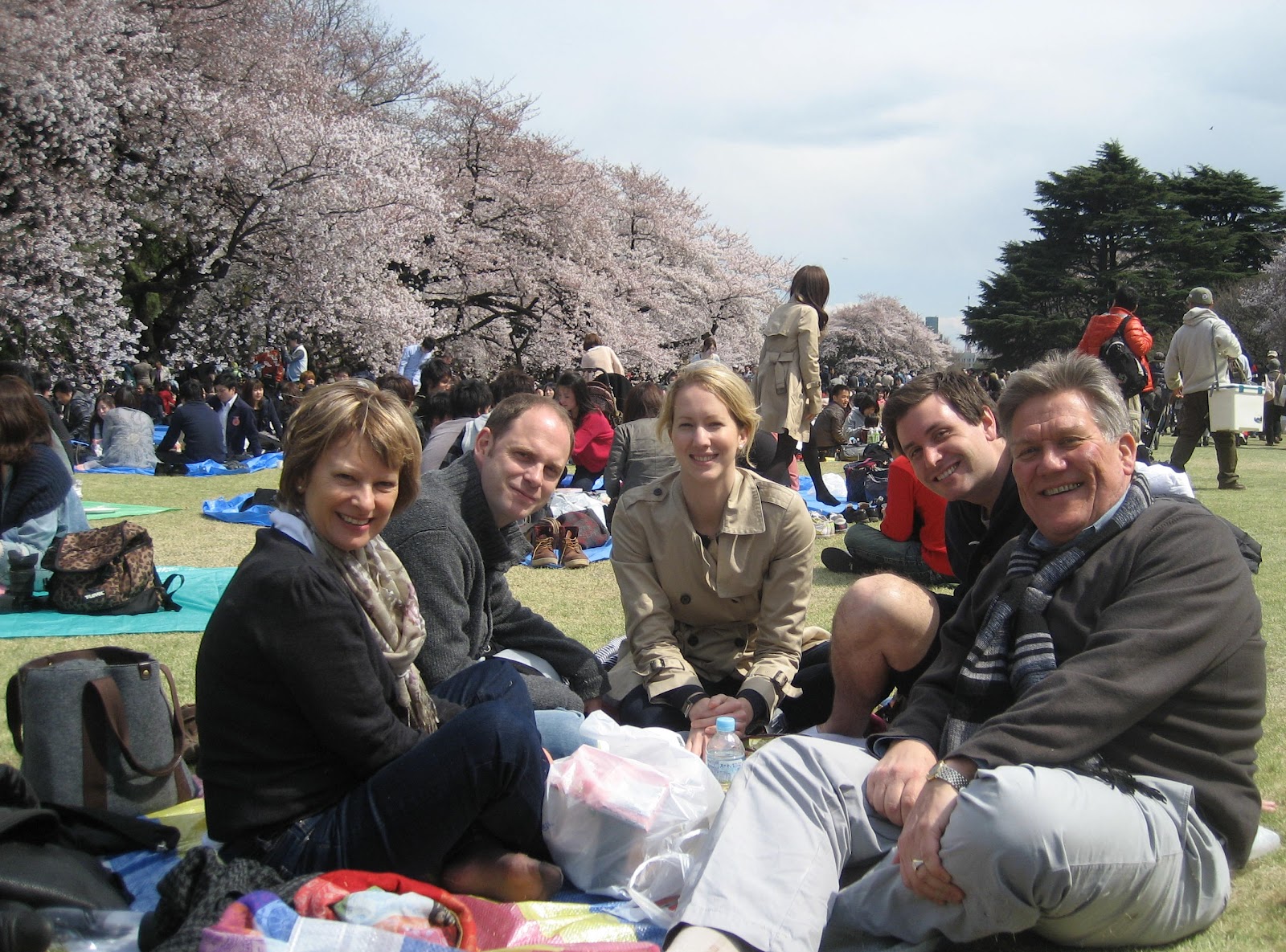
After a slow and slightly late start to the season, weather and blossom forecasts were proclaiming that the weekend of 7th and 8th April would be the time for hanami parties. My Japanese friends began to make preparations for their parties so I did the same. I was hoping the weekend would be as good as promised as I had scheduled a picnic for the Saturday to mark the arrival of my Dad and step-Mum in Tokyo, and the visit of some more friends. Being English I’m more than used to summer BBQs being called off, or finished off in the oven while soggy guests squeeze into the kitchen drinking Pimm’s and pretending that the downpour outside is a tropical storm…but a blossom viewing party from inside a high-rise apartment? That would never do. Fortunately it didn’t have to as Saturday turned out to be sunny and warm. We joined the throngs of other people taking advantage of the weather and headed to Shinjuku Gyoen where I spread my newly acquired leisure sheet on the grass by an avenue of cherry trees and we all tucked into our onigiri, rice crackers and edamame while taking furtive sips from the water bottle into which I’d poured sake. The garden has a no alcohol policy so we watched many people in the queue decanting their booze into less obvious containers. We never did find out what happened to the guy who was cradling a whole box of Asahi beer…!

Our very own hanami picnic in Shinjuku Gyoen

More hanami followed the next day as we walked around Chidorigafuchi, at the north end of the Imperial Palace grounds. Here there are huge, candyfloss-like sakura trees, whose branches stretch right down to the moat. It was breathtaking. The Indian Embassy had embraced the party atmosphere, throwing its gates open and providing food and beer stalls and music so we sat in the sunshine among the crowds and soaked it all up.


Perfect blossoms in front of the Imperial Palace moat

Giant candyfloss trees

Serenity right in the middle of the city

The rest of the week continued to be all about the sakura, with our travels taking in Rikugi-en, Hama-Rikyu, Sumida Park, Ueno Park, Yoyogi Park, Yanaka and the waterfront in Yokohama (where I’ve now seen the trees that hadn’t blossomed last week!). Yokohama was preparing for a big horticultural festival over the weekend so in addition to the sakura there were the most magnificent beds of tulips and mixed borders that had all come out in the sunshine. Everywhere there have been flowers there have been people with picnic mats, food and drink. The atmosphere has been that of a giant party zone, a hub of community spirit and outdoorsy-type fun. Truly wonderful.

The famous shidare zakura (weeping cherry tree) in Rikugi-en

Lining the Sumida River at Asakusa

Stunning tulips in Yokohama

Breathtaking

As I write this it’s actually chucking it down with rain outside, which makes a bit of a difference from the rest of the week. However tomorrow is set to be sunny again so we’re off to have a last look before the wind blows all the blossoms down. This in itself is a beautiful experience – it’s like being in a snow storm that’s neither cold nor wet.  The sakura season is definitely almost over but it’s been fantastic and at last I’ve been able to see what all the fuss is about. It’s brilliant to have been able to experience such an important event in the Japanese calendar, to have seen Tokyo with its party outfit on, and to have joined in the fun in the fantastic weather. I’ll be back to do it again!


またね!

Wednesday, 21 March 2012

Manners Maketh Man (and Woman?)

The beginning of March marked our six month anniversary of living in Tokyo. While six months is not long enough to really get to know a city like this and its people, I have been struck over and over again by two observations. Firstly, that people here are unflinching in their commitment to manners and politeness. Secondly, that Tokyo is a city full of contradictions.

Manners and politeness are codified within the language. Japanese, like many languages, has a formal and an informal version. The use of these depends on your audience e.g. a stranger, a colleague, a child, a family member, a friend, a teacher etc. It also has an honorific form, used when a person has a higher social status than the speaker. Interestingly, the informal, formal and honorific versions of the same verb are often so different that they can appear to be totally unrelated. I have not really tackled the honorific in my language lessons yet – your average foreigner will not need to use it very often at all – but I have been grappling with the formal and informal. The fact that they are confusing is not an excuse for shirking; as my teacher said to me, ‘yes this is difficult. But it’s important so we need to learn it properly.’ I see this as a kind of good manners – showing respect to the language in which I want to be able to communicate and to the long-suffering teacher who is helping me learn. On a daily basis Japanese people show this respect to their friends, their co-workers, their family.

The emphasis on manners can also be seen in numerous places while out and about. When you get on a train, you are asked to switch your mobile phone to ‘manner mode’ (silent) and people rarely infringe on others’ thoughts by talking on the phone. Instead, train carriages are largely silent, with travellers reading books or playing games on their phones. On most staircases in public areas there are signs telling you which side to use to go up, and which to go down, and at a local station I observed a notice at the top of the stairs asking people to pay attention to these directions. It roughly translated as ‘Because of manners there are rules. If the rules are there, the manners are there.’

There is also an overriding sense that your actions should not in any way inconvenience others. It has been interesting when I’ve held a door for someone, or let them pass on a narrow path, that instead of the response being a straight out ‘thank you’, it has been a word that equates to ‘I’m sorry’ or ‘excuse me’, i.e. apologising that they’ve in some way put me out. When entering or leaving a room, or ending a phone conversation, it is customary to use a word that literally translates as ‘I’m being rude’ and implies a request for forgiveness.

I spent a very interesting morning at a ‘Manners Salon’, where I began to learn some of the finer points of Japanese etiquette, especially as it relates to social occasions. Sensei, immaculate in attire and deportment, took a roomful of confused but willing participants through the correct way to wrap and present your host’s gift; fold your coat before you arrive at your host’s house; remove your shoes and tidy them, entering the house without turning your back on your host; enter and leave the entertaining room; pull apart your chopsticks and make a rest for them; get on and off your cushion at the table. As sensei put it, ‘manners equal love’. My mind was whirling with all the instructions I received and I was horrified by the thought that I may unknowingly have offended someone prior to learning all of this. However when speaking to my Japanese friends after the salon (mainly women of a similar age to me), they all laughed and said that I knew more about traditional manners than they did. Part of this response was Japanese manners in action – it is polite to claim that you know less than someone, even if it’s not the case – but partly it was an indication that in today’s Japan, many of the old ways of doing things are slowly being phased out. Not all of them though – my friends still dip their head to me in an almost-bow when we part (it’s not a full bow because I’m a foreigner and I think they think I’d find it weird!)

One of the old ways of doing things that I would not mind seeing phased out is the attitude towards women, especially in large companies. This is one of those contradictions that I mentioned earlier: everyone deserves respect and to be treated politely, but if you are a man, women should respect you even more whereas you do not have to reciprocate. Of course, this is not the case in all companies, or with all men or women. But in what I have so far seen and heard, women are often consigned to the role of secretary or receptionist and are consistently spoken down to by their male colleagues. One of my Japanese friends says she believes that Japanese women are also perceived in a certain way by foreign men – as submissive, quiet and grateful for male attention.  Sadly, I have observed this kind of attitude in action, although I did seek to persuade my friend that not all men are like this. I also suggested she take up a martial art; men are less likely to treat you like a doormat if they know you can kick them in the head. Not that we should have to prove ourselves like this in the first place, and it wouldn’t be terribly good manners either…

Another contradiction of good manners I have occasionally observed and experienced is the treatment of foreigners. Attitudes towards me have bounced from hyper-politeness because I am often in the role of visitor, guest or customer, to healthy curiosity and amusement because I’m different, to dislike or rudeness because I’m an intruder, an unwelcome addition. Without a doubt, the best way I have found of dealing with the less-welcoming situations is to keep learning and trying to use the language, and maintain my own manners and politeness at all times. It’s not rocket science really, just good communication and common sense and I don’t think this is different anywhere in the world.

For the most part however, I am still struck on a daily basis by the politeness and good manners of the vast majority of people with whom I come into contact. The person who welcomes me into a shop and takes my basket to the checkout for me; the complete strangers who have offered me assistance finding places when I’ve been lost; the never-ending patience of my Japanese teacher who apologises when I don’t understand something; the ground crew at the airport who bowed to our plane as we took off to go on holiday: this is a country where politeness and manners matter and can be found all over the place.

Before I came to Japan I had been noticing in the UK for a while an increasing tendency towards complaining and being rude. I am not for a second suggesting that we should always put up and shut up because it’s more polite that way, but would it not be better to put this negative energy to more constructive use by getting on with things, showing respect for our fellow human beings, and employing good manners at all times? In my experience, being happy and polite is far less exhausting than being miserable and rude. And, as my grandmothers both used to say to me, manners cost nothing.

I think we can definitely learn a lot from the Japanese approach to politeness and manners. Life here isn’t perfect, not by a long shot, but there are some really interesting ideas and attitudes that I want to retain after I return to the UK, which is also far from perfect. But perfection is possibly neither achievable nor desirable. If it were life wouldn’t be nearly as fascinating.

またね!